NAD+

Independent guide to NAD+ injections
What is NAD+? The coenzyme in every cell, why its decline with age drives the injection trend, how it is sold in 2026 and what the evidence does not show.
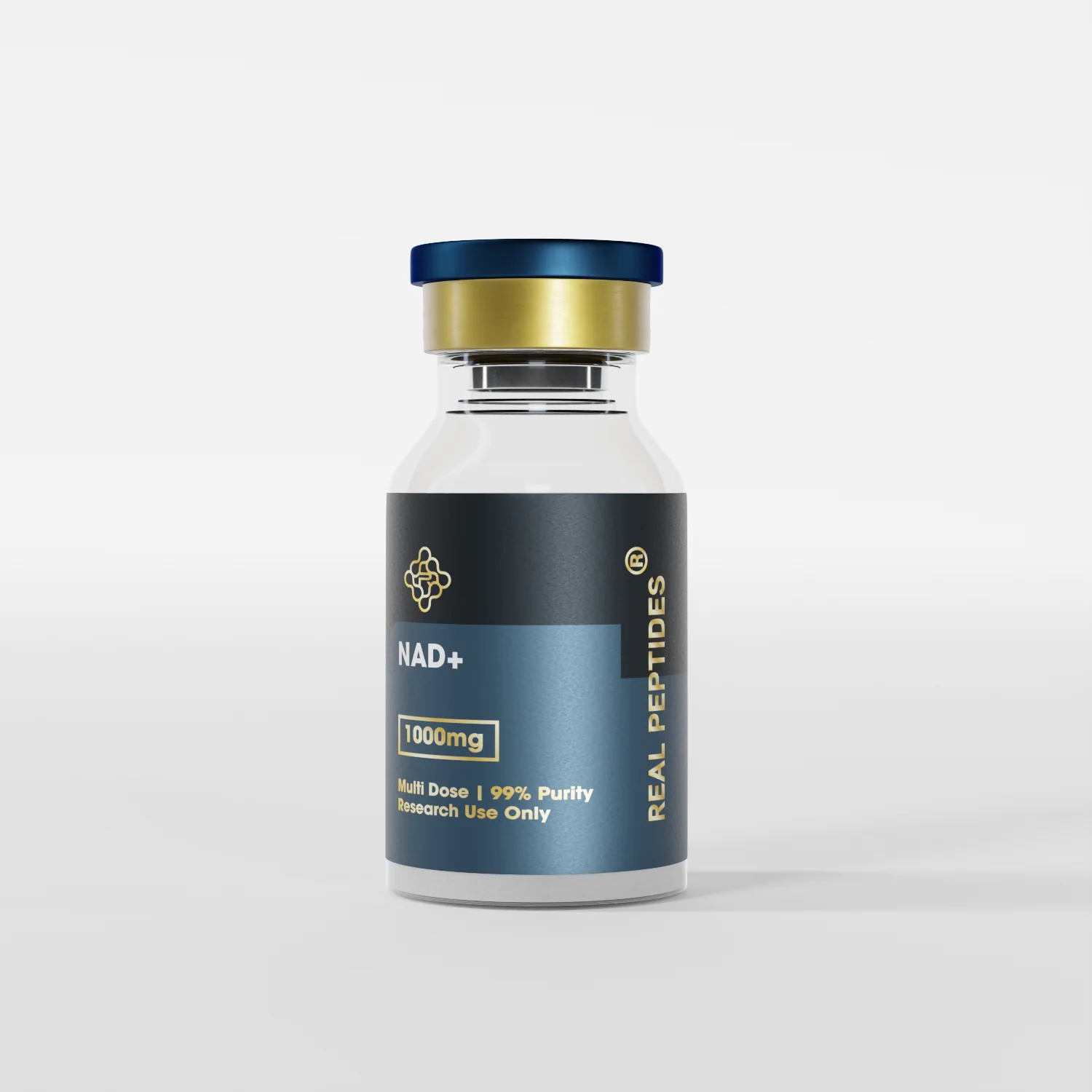
NAD+ injections now sell for anywhere from $60.00 as a research vial to $299.99 as a telehealth prescription program, all built on a molecule that sits in every cell of your body. So what is NAD, and why has a coenzyme from biochemistry textbooks become a clinic menu item? The short answer is that NAD+ is central to energy metabolism and its levels decline with age in many studies, and that pairing has been turned into a market.
This page covers the biology, the jump to injections, and what is and is not established. Injectable NAD+ is not an FDA-approved drug.
NAD+ (nicotinamide adenine dinucleotide) is a coenzyme, a helper molecule that enzymes need to do their work, and it is present in every cell. Its best-known role is in energy metabolism: it helps cells turn nutrients into usable energy.
The "+" in the name refers to the oxidized form of the molecule, the form that accepts electrons during metabolic reactions. When people ask what is NAD versus NAD+, they are usually asking about the same coenzyme; the plus sign just specifies its state. Clinics and vendors use "NAD" and "NAD+" interchangeably on their menus.
Because it is involved in such basic processes, NAD+ appears in a huge range of lab research. That breadth is part of why it attracts marketing: almost any health claim can be tied to "cellular energy" in some way. Being involved in a process is not the same as being a treatment for it.
Many studies report that NAD+ levels decline with age, and that finding is the main reason NAD+ became linked to longevity. The reasoning sellers use runs like this: levels fall, ageing happens, so restoring levels might slow ageing.
The first two parts are observations. The third is a hypothesis that needs controlled human trials of the actual product to confirm. For injectable NAD+, human evidence on energy, ageing and weight is limited, and the strongest data come from cell and animal models. We cover the claim-by-claim picture on NAD injection benefits.
NAD+ reaches buyers today in four main forms, each sold under different rules:
Only the first two are routes for people under medical supervision. Our NAD vs NMN vs NR page explains how the precursors differ from NAD+ itself.
Several things buyers assume about NAD+ are not established by controlled human trials. Weight-loss claims are not supported. Long-term safety of repeated injections has not been shown. And how well NAD+ is absorbed by some routes is uncertain: Arc-1 itself lists limited bioavailability data for its nasal spray.
Side effects are better documented than benefits. Clinics commonly report flushing, nausea, chest tightness or cramping when NAD+ IV infusions are given fast. Those reports come from clinic experience, not trials, but they are consistent enough that clinics plan around them.
Several research compounds are often discussed next to NAD+ because they touch related pathways, though none is an NAD+ product. MOTS-c is a mitochondria-derived peptide studied in metabolism and exercise research. Glutathione is an antioxidant tripeptide the body makes. Epithalon comes from Russian ageing research. All are sold by Real Peptides as research use only, at $43.20, $40.80 and $24.00 respectively.
Seeing them grouped together on a menu does not mean they work together. Our NAD+ longevity compounds page sets out what each one is and what the research covers.
Injectable NAD+ is not an FDA-approved drug, and research vendors sell it labelled "for research use only / not for human consumption". On 24 August 2026, FDA sent warning letters to five online peptide vendors for selling unapproved new drugs. NAD+ was not among the products named, but FDA stated that it judges a vendor by its whole website, including dosing guidance and disease claims.
So when you ask what is NAD in a legal sense, the answer depends on the channel: a prescribed compounded product, a clinic service, a supplement precursor or a research chemical. I think that distinction is the single most useful thing a new buyer can learn. If you are considering NAD+ for yourself, talk to your doctor, and see how NAD+ prescriptions work.
NAD+ injections now sell for anywhere from $60.00 as a research vial to $299.99 as a telehealth prescription program, all built on a molecule that sits in every cell of your body. So what is NAD, and why has a coenzyme from biochemistry textbooks become a clinic menu item? The short answer is that NAD+ is central to energy metabolism and its levels decline with age in many studies, and that pairing has been turned into a market.
This page covers the biology, the jump to injections, and what is and is not established. Injectable NAD+ is not an FDA-approved drug.
NAD+ (nicotinamide adenine dinucleotide) is a coenzyme, a helper molecule that enzymes need to do their work, and it is present in every cell. Its best-known role is in energy metabolism: it helps cells turn nutrients into usable energy.
The "+" in the name refers to the oxidized form of the molecule, the form that accepts electrons during metabolic reactions. When people ask what is NAD versus NAD+, they are usually asking about the same coenzyme; the plus sign just specifies its state. Clinics and vendors use "NAD" and "NAD+" interchangeably on their menus.
Because it is involved in such basic processes, NAD+ appears in a huge range of lab research. That breadth is part of why it attracts marketing: almost any health claim can be tied to "cellular energy" in some way. Being involved in a process is not the same as being a treatment for it.
Many studies report that NAD+ levels decline with age, and that finding is the main reason NAD+ became linked to longevity. The reasoning sellers use runs like this: levels fall, ageing happens, so restoring levels might slow ageing.
The first two parts are observations. The third is a hypothesis that needs controlled human trials of the actual product to confirm. For injectable NAD+, human evidence on energy, ageing and weight is limited, and the strongest data come from cell and animal models. We cover the claim-by-claim picture on NAD injection benefits.
NAD+ reaches buyers today in four main forms, each sold under different rules:
Only the first two are routes for people under medical supervision. Our NAD vs NMN vs NR page explains how the precursors differ from NAD+ itself.
Several things buyers assume about NAD+ are not established by controlled human trials. Weight-loss claims are not supported. Long-term safety of repeated injections has not been shown. And how well NAD+ is absorbed by some routes is uncertain: Arc-1 itself lists limited bioavailability data for its nasal spray.
Side effects are better documented than benefits. Clinics commonly report flushing, nausea, chest tightness or cramping when NAD+ IV infusions are given fast. Those reports come from clinic experience, not trials, but they are consistent enough that clinics plan around them.
